Nowatel Defense XR
Nowatel Defense XR
VR/AR training system for the military
Nowatel delivers a complete XR (VR/AR/MR) training ecosystem designed for the needs of the armed forces — from rapid scenario authoring and content management to field service support and remote expert assistance. We deploy the solution under the Nowatel brand, leveraging our subcontractor’s proven technology and full integration with the client’s infrastructure.
Key capabilities
No‑code content creation
Instructors and training officers build interactive scenarios in an intuitive editor — without writing code. This enables quick creation of courses with procedures, SOP/TTP, checklists, and error assessment.
XR headset compatibility and standalone operation
The system runs on a wide range of OpenXR headsets (incl. Quest 2/3/Pro, HTC Focus 3/Elite, Apple Vision Pro), with no cables and no dependency on extra components like SteamVR.
Web console for management and publishing
The web panel enables user administration, content publishing, AI‑based translations and voice commands, as well as versioning and distribution of exercises to selected units.
3D model import and CAD support
We use GLB models and provide conversion from most CAD formats — ideal for training equipment, vehicles, and weapons operation.
Analytics and assessment
We collect metrics (time, number of errors, retries) to measure progress, bottlenecks, and training effectiveness.
Flexible deployment: SaaS or On‑Prem (Docker)
We deploy in private/state clouds or on‑prem in ministry networks — with encryption, access control, and compliance with security policies.
Field Service & Procedures module (AR in the field)
- Create “in‑situ” instructions — recording step by step directly at the device with references to location and a specific unit (device template).
- 2D and AR access — instructions available on smartphone/tablet (2D view, PDF) and in AR (WebXR) and on XR headsets — ideal in the workshop, on the training ground, and in distributed operations.
- IoT integration — real‑time signals/telemetry during the procedure.
- AI translations and standardization — automatic multilingual versions of instructions for multinational detachments.
- Remote expert assistance — an expert connects via a browser, sees what the soldier sees, and guides them step by step.
Use cases in the armed forces
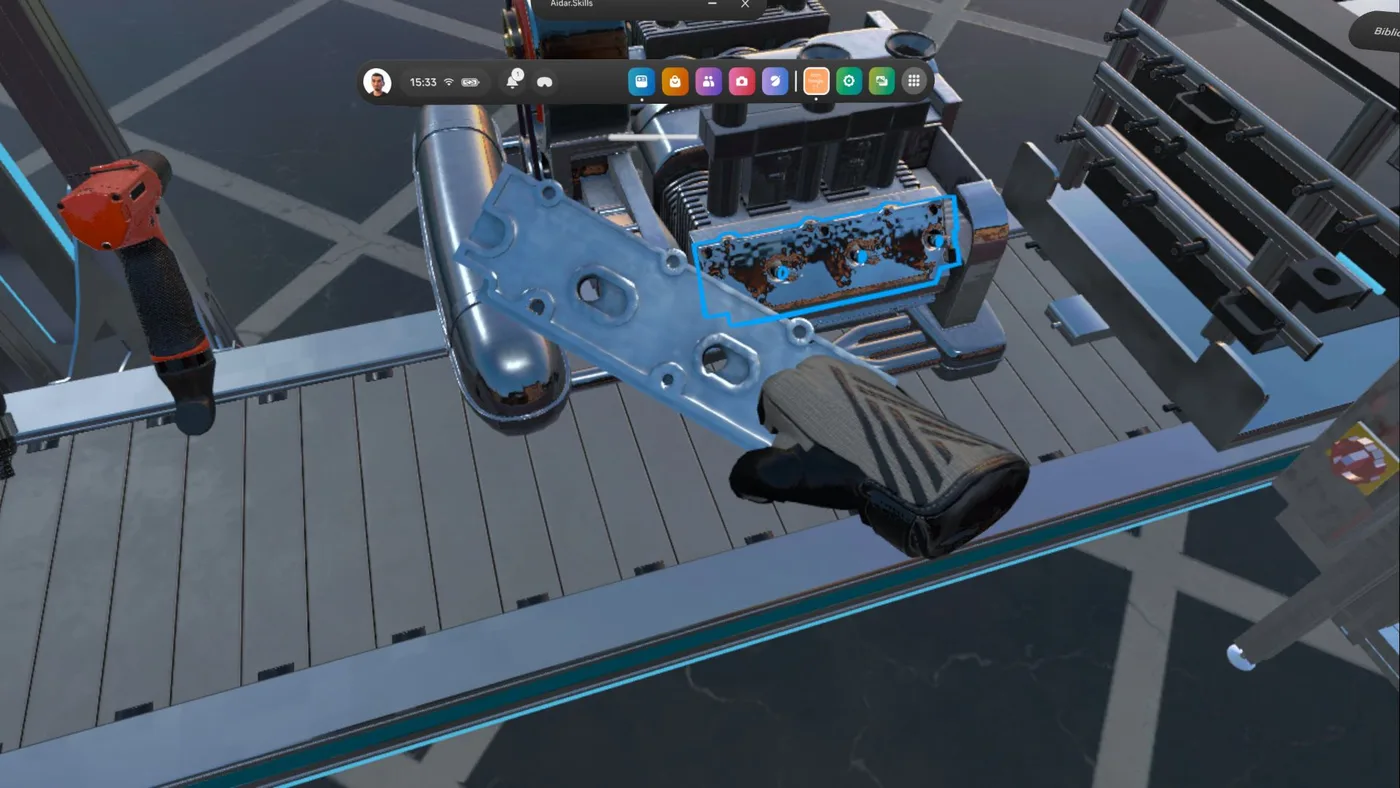
- Equipment operation and training: vehicles, communications systems, firing positions, logistics sets — training of operational, assembly, and diagnostic activities.
- Tactical and safety procedures: SOP/TTP, MEDEVAC evacuation, CBRN, operations in contaminated areas — without risk to people and equipment.
- Field service and maintenance: AR “hands‑free” with IoT data, remote diagnostics, and rapid troubleshooting.
- Certification courses: from basics to advanced qualifications — with measurable grading and reporting.
Measurable outcomes
- Cost and time savings thanks to reduced travel, room rentals and instructor workload, and the ability to train at any time.
- Higher engagement and retention — immersive experiences increase focus and confidence in executing procedures (muscle memory effect).
- Fewer errors and lower material consumption — from an automotive case study: assembly errors ↓ ~40% and material usage ↓ ~30%.
- Faster and cheaper service — from industrial deployments: up to ~50% shorter service time, ROI in ~5 months and ~20% shorter inspection time.
Security and architecture
- On‑Prem (Docker) or cloud — local version for networks with elevated security requirements; full encryption, access control, and regulatory compliance.
- Anti‑cybersickness design — scenarios without forced camera movements, minimizing the risk of nausea in VR.
- Audit trail and analytics — detailed user and exercise metrics to evaluate training program effectiveness.
Hardware and access
- XR headsets: full support for OpenXR devices (e.g., Quest 2/3/Pro, HTC Focus 3/Elite, Apple Vision Pro).
- Smartphones/tablets: browser access (WebXR) — 2D and AR modes; export instructions to PDF.
How we deploy in Units
- Needs analysis — competency matrix, procedure catalog, priorities.
- Proof‑of‑Concept — rapid creation of pilot scenarios based on 3D/CAD models.
- Integration and security — On‑Prem (Docker), access control, data policies.
- Roll‑out and staff training — train‑the‑trainer, dashboards and KPIs.
FAQ (selected)
Will the system work for complex procedures?
Yes. The no‑code editor and CAD import allow modeling complex operational and tactical activities, and AR in the field supports diagnostics and service.
Can content be multilingual?
Yes. The console offers AI translations and distribution of language versions to designated groups.
What does field support look like?
The operator runs the instruction on a smartphone/headset; an expert can join remotely via a browser and guide them step by step.
Does VR cause “simulator sickness”?
We design scenarios without unnatural camera movements, minimizing discomfort; additionally, sessions are short and frequent, which increases learning effectiveness.